
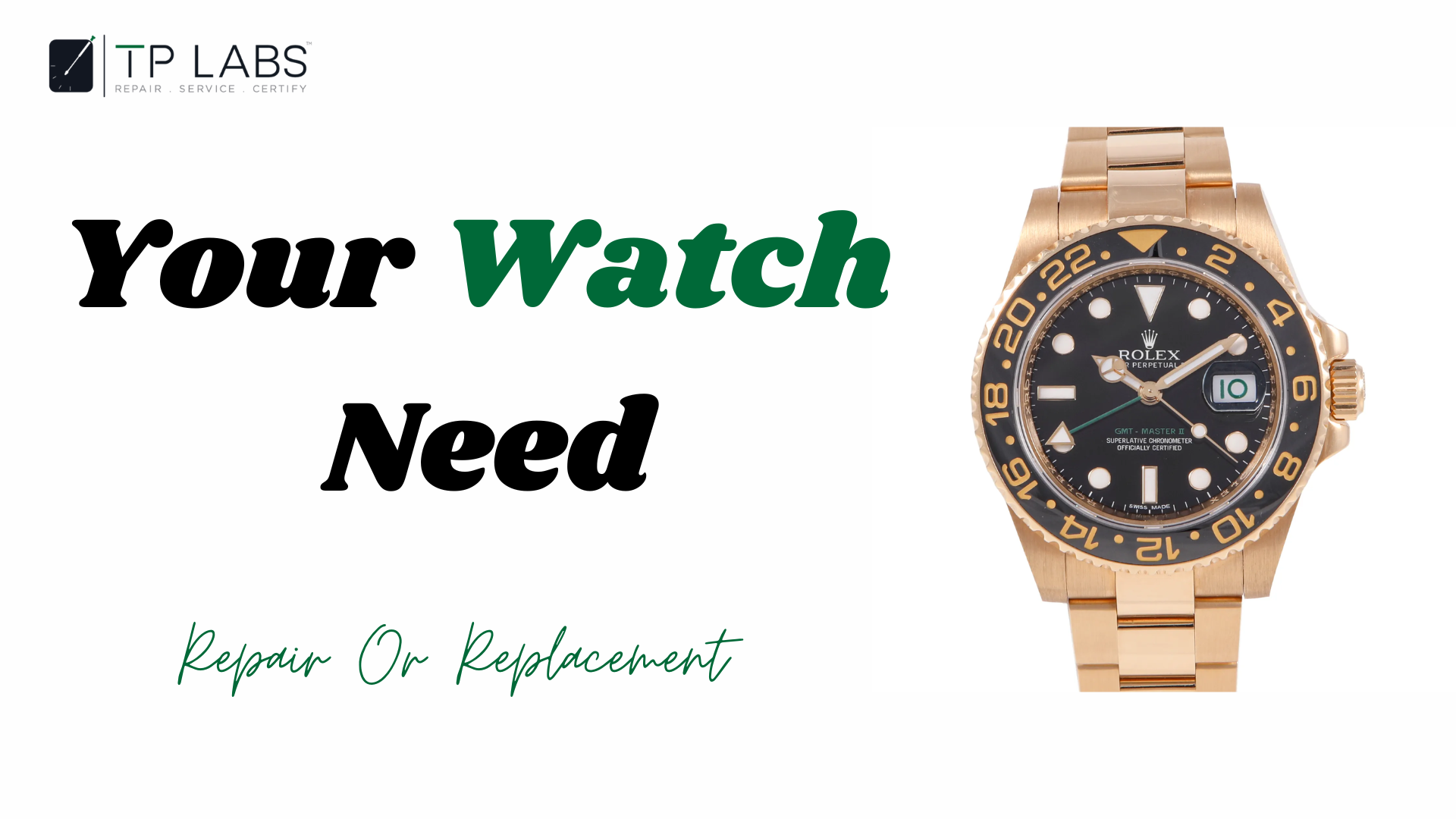
A luxury watch rarely tells you exactly what is wrong with it.
It may simply stop running. It may begin losing a few minutes. The crown might suddenly feel different when you wind it. There could be condensation beneath the crystal, an unusual sound from the movement, or a problem with the date changing.
For the owner, these symptoms can raise a straightforward question: does the watch need repair, a complete service, or should it be replaced altogether?
In most cases, the answer should not be decided by the symptom alone.
A mechanical watch is a system of small components working together under controlled friction, tension and lubrication. A problem that looks minor from the outside can sometimes point to wear or damage inside the movement. Conversely, a watch that has stopped may not necessarily need an extensive repair.
That is why a professional inspection should come before making a decision.
When Does a Watch Actually Need Repair?
Not every watch that stops is broken.
An automatic watch can stop simply because it has not been worn or wound for long enough. Some watches can also stop because the power reserve has run down. But if a fully wound watch repeatedly stops, loses significant time, or develops a new mechanical symptom, it deserves closer attention.
Common signs that a watch may require professional watch repair include:
- The watch has stopped unexpectedly
- It is consistently gaining or losing noticeable time
- The power reserve has become significantly shorter
- The crown feels loose, stiff or unusually rough
- The hands do not move correctly
- The date or other complications fail to change properly
- The watch has suffered a strong impact
- There is condensation beneath the crystal
- The crystal, crown or case has been damaged
- The watch has not received professional servicing for many years
The important distinction is between a symptom and a diagnosis.
For example, poor timekeeping does not automatically mean that the movement needs to be replaced. It could involve regulation, lubrication, magnetism, wear or another mechanical issue. A watchmaker needs to examine the watch before determining the cause.
7 Signs Your Luxury Watch Needs Professional Watch Repair
1. Your Watch Has Stopped Running
A stopped watch is one of the most common reasons owners seek a repair service, but it is also one of the easiest symptoms to misinterpret.
If an automatic watch has been sitting in a drawer, its power reserve may simply have run out. The first step is therefore to establish whether the watch starts and maintains its operation after being correctly wound or worn.
If it repeatedly stops despite having sufficient power, the situation is different.
The movement may have a mechanical fault, excessive friction, worn components or another issue that requires professional diagnosis.
A watchmaker can determine whether the problem is minor or whether the movement needs more comprehensive attention.
2. The Watch Is Losing or Gaining Too Much Time
Mechanical watches are not expected to behave like quartz clocks down to the last second.
However, a noticeable change in timekeeping compared with the watch’s previous performance should not simply be ignored.
Accuracy can be affected by several factors, including the condition of the movement, lubrication, regulation, magnetism, shocks and component wear.
Rolex, for example, describes accuracy testing and final regulation as part of its servicing procedure. After servicing, its watchmakers measure chronometric precision and make final adjustments where necessary.
The lesson is broader than Rolex: timekeeping should be diagnosed, not guessed at.
3. The Crown Feels Different
The crown is one of the most frequently handled parts of a mechanical watch, yet owners often overlook changes in how it feels.
A crown that suddenly becomes unusually stiff, loose or difficult to operate deserves attention.
The crown and winding system are connected to important parts of the movement, while the crown and its seals also play a role in protecting the watch from water.
On Rolex Oyster watches, for example, the screwed-down crown forms part of the case’s sealing system. Rolex specifically emphasizes that the crown must be screwed down correctly to maintain waterproofness.
If the crown no longer feels normal, forcing it is rarely the right response.
4. There Is Moisture Under the Crystal
This is one symptom that should never be treated as merely cosmetic.
Condensation beneath the crystal can indicate that moisture has entered the case. Once water reaches the movement, corrosion and other damage can develop.
A watch that has been exposed to water and subsequently develops condensation should be inspected as soon as possible.
Water resistance is also not a permanent characteristic that can simply be assumed throughout the life of a watch. Seals age, components can be disturbed by impact or servicing, and the condition of the case matters.
Professional servicing therefore includes appropriate water-resistance checks. Rolex’s published service procedure, for example, includes pressure testing the case after servicing.
5. The Watch Has Been Dropped or Hit
Luxury watches are built to be worn, but that does not make them immune to impact.
A strong impact can affect the case, crystal, crown, bracelet or components inside the movement. Sometimes the external damage is obvious. Sometimes the watch looks perfectly normal but begins behaving differently afterward.
If a watch starts losing time, stops, or develops an unusual sound following a significant impact, it should be inspected rather than simply worn until the problem becomes worse.
6. The Crystal, Crown or Bracelet Is Damaged
Not every repair is a movement repair.
A cracked crystal, damaged crown, worn bracelet component or compromised seal can require attention even when the movement itself is operating normally.
This is one reason the term watch repair covers a much wider range of work than simply fixing a stopped movement.
The technician’s job is to identify the failed or damaged component and determine whether it can be repaired, adjusted or needs replacement.
7. Your Watch Has Not Been Professionally Serviced for Years
A watch can continue running for years without obvious problems and still benefit from professional servicing.
Inside a mechanical movement, numerous components operate against one another. Lubricants are there to control friction, but they do not remain unchanged forever.
Rolex states that it recommends periodic servicing and currently advises approximately every 10 years, depending on the model and real-life usage.
That does not mean every luxury watch should automatically be serviced every 10 years. Service intervals vary by manufacturer, movement, model, age and usage.
The important point is that service history matters.
Watch Repair vs. Watch Servicing: What’s the Difference?
The terms are often used interchangeably, but they describe different types of work.
Watch repair generally addresses a specific fault or damaged component.
Watch servicing is broader. It involves inspecting and maintaining the watch so that the movement, case and other components can continue to function properly.
A simple example makes the difference clearer.
If a watch has a damaged crown, replacing or repairing that component may solve the immediate problem.
A complete service, on the other hand, can involve dismantling the movement, inspecting its components, cleaning, lubrication, reassembly, regulation and testing.
Rolex describes its complete service as a process in which the movement, case and bracelet are examined separately. The movement is disassembled, components are inspected, lubrication is renewed and the watch is subjected to technical checks before being returned to the owner.
So, repair fixes a problem; servicing looks more broadly at the condition and performance of the watch.
What Happens During a Professional Watch Repair?
A proper repair should not begin with someone immediately opening the case and replacing parts.
It begins with diagnosis.
1. Initial Inspection
The watchmaker first examines the overall condition of the watch.
This can include the case, crystal, crown, bracelet, movement behavior and any symptoms reported by the owner.
2. Diagnosis
The next step is determining what is actually causing the problem.
If a watch is losing time, for example, the technician needs to establish why. If it has stopped, the question is whether the problem is related to winding, the power delivery system, the regulating system or another part of the movement.
3. Movement Inspection
When the diagnosis indicates an internal problem, the movement can be examined more closely.
This is where professional equipment and watchmaking experience become important.
A luxury movement is not something that should be treated like a generic machine. Components are extremely small, tolerances can be tight and incorrect handling can create additional problems.
4. Repair or Component Replacement
Once the fault is understood, the appropriate repair can be determined.
Depending on the watch, this could involve adjustment, cleaning, replacement of a worn component, repair of a particular mechanism or a more extensive movement service.
The correct approach depends on the actual condition of the watch.
5. Cleaning and Lubrication
For a complete movement service, cleaning and lubrication are fundamental parts of the process.
The purpose is not simply to make the movement look clean. Proper lubrication helps control friction between moving components.
Rolex specifically notes that the accuracy of its movements depends in part on high-performance lubricants designed to minimize friction and component wear.
6. Reassembly and Regulation
After the necessary work is completed, the movement is reassembled and its performance is checked.
If regulation is required, the watchmaker adjusts the movement to achieve the appropriate timekeeping performance.
7. Water-Resistance Testing
If the watch is designed to provide water resistance, testing is an important part of professional servicing.
This is particularly relevant after work involving the case, crown, crystal or seals.
A professional repair should therefore consider not only whether the watch is running, but whether the watch remains suitable for the conditions in which it is intended to be worn.
8. Final Checks
The watch should undergo final functional checks before it returns to its owner.
For example, Rolex’s published service procedure includes a precision test lasting at least 24 hours, followed by waterproofness testing and final control.
That gives a useful perspective on what professional servicing actually involves: the job is not finished simply because the hands have started moving again.
How Much Does Watch Repair Cost in Dubai?
There is no honest single price for watch repair.
The cost depends on what is wrong with the watch and how extensive the required work is.
Factors can include:
- The brand and model
- Movement type
- Age of the watch
- Nature of the fault
- Condition of the movement
- Parts required
- Water damage
- Previous repair history
- Extent of disassembly required
- Whether cosmetic work is also requested
A watch that needs a simple component replacement is obviously a different job from one requiring a complete movement overhaul.
This is why a professional inspection should come before quoting a final repair cost.
For owners of expensive watches, the cheapest initial quote is not necessarily the most useful number. The more important questions are what is actually being repaired, what parts are being used, what testing is performed, and what condition will the watch be returned in?
Can Every Luxury Watch Be Repaired?
Not necessarily in the same way.
The age and condition of a watch can make a significant difference.
A modern watch may have readily available replacement components, while an older or discontinued model can require more specialized work. Vintage watches can be particularly challenging because preserving the character and originality of the timepiece may matter as much as making it function again.
Rolex provides an interesting example of long-term serviceability. The brand states that parts and labour are assured for every watch for at least 35 years after it has been withdrawn from the catalogue, with exceptional historic watches handled by its restoration atelier when required.
That figure is specific to Rolex and should not be applied to every watch brand.
The broader point is that the age of a watch does not automatically mean it is beyond repair.
A qualified watchmaker should assess the watch before that conclusion is reached.
Should You Repair a Rolex, Omega or Audemars Piguet?
The same basic principle applies whether the watch is a Rolex, Omega, Audemars Piguet, Patek Philippe or another high-end mechanical timepiece.
The brand is important, but it is not enough to determine the correct repair.
The watchmaker also needs to consider:
- The exact model and reference
- Movement condition
- Age
- Service history
- Damage
- Parts availability
- Previous modifications
- The owner’s intended use
With valuable watches, originality can also matter.
A collector may care about preserving original components and finishing. Another owner may simply want the watch returned to reliable daily use.
The repair approach should therefore reflect the watch itself and the owner’s requirements.
Why You Shouldn’t Attempt Luxury Watch Repair at Home
There is a difference between caring for a watch and repairing one.
Keeping the case clean, storing the watch correctly and following the manufacturer’s instructions are sensible forms of routine care.
Opening the case and attempting to work on the movement is another matter.
A DIY repair can create problems that did not exist originally:
- Scratched case backs
- Damaged screws
- Contaminated movement components
- Incorrect lubrication
- Damaged seals
- Improper regulation
- Lost or incorrectly installed components
The risk is particularly significant with complicated mechanical watches.
A professional watchmaker has the appropriate tools, equipment and working environment to inspect and handle the movement properly.
When Is Replacement Better Than Watch Repair?
The word “replacement” can also be misleading.
In many cases, it does not mean replacing the entire watch.
It may mean replacing one component.
For example:
- A damaged crystal may need replacement
- A worn gasket may need replacement
- A damaged crown may need replacement
- A worn movement component may need replacement
- A damaged bracelet component may need replacement
The decision should come after diagnosis.
If the movement itself is severely damaged, the repair may become more involved. But even then, replacing the entire watch is an ownership decision rather than a technical diagnosis.
A valuable or sentimental watch should not be written off simply because it has stopped working.
Why Professional Watch Repair Matters for Luxury Watches
A luxury watch is a precision instrument, not simply an expensive accessory.
That distinction matters when choosing where to take it.
Professional watch repair involves more than making the watch run again. The condition of the movement, case, seals and other components needs to be considered together.
The manufacturer’s own servicing procedures illustrate this clearly.
Rolex’s published process includes assessment, movement disassembly, component inspection, cleaning, lubrication, reassembly, precision testing, waterproofness testing and final control. Its worldwide service network covers more than 100 countries.
The specific procedures will vary between brands and independent watchmaking workshops, but the principle remains the same:
Good watch repair is about diagnosis, careful workmanship and verification—not simply replacing a part and handing the watch back.
Watch Repair in Dubai at TP Labs
For owners in Dubai, the first step should be to have the watch assessed before deciding what work it needs.
TP Labs provides watch-related services including repair, servicing, authentication, polishing and other specialist work. The appropriate service depends on the condition of the individual watch.
If a watch has stopped, is losing or gaining time, has suffered an impact, shows signs of water exposure or simply has not been serviced for many years, a professional inspection can establish what should happen next.
That may be a specific repair.
It may be a complete service.
It may be a component replacement.
Or, in some cases, the watch may require no major intervention at all.
That diagnosis is what makes professional watch repair different from simply trying to fix a symptom.
Frequently Asked Questions About Watch Repair
How do I know if my watch needs repair?
A stopped watch, unusual timekeeping, a loose crown, water exposure, unusual movement sounds or physical damage can all justify a professional inspection. The symptom alone does not determine the required repair.
How much does watch repair cost in Dubai?
There is no universal price. The cost depends on the brand, movement, fault, parts required and extent of the work. A proper diagnosis is needed before an accurate estimate can be given.
Can a luxury watch be repaired after water damage?
It can often be assessed and repaired, but the outcome depends on how much moisture entered the watch and how long it remained inside. Water damage should be addressed promptly because corrosion can affect movement components.
Is watch servicing the same as watch repair?
No. Repair normally addresses a specific fault, while servicing is broader and can include movement disassembly, cleaning, lubrication, inspection, reassembly and testing.
How often should a luxury watch be serviced?
There is no universal interval for every watch. Manufacturers provide their own recommendations. Rolex, for example, currently recommends servicing approximately every 10 years depending on the model and real-life usage.
Can an old luxury watch still be repaired?
Age alone does not determine whether a watch can be repaired. Parts availability, movement condition, construction and the availability of appropriate watchmaking expertise all matter.
Should I repair my watch or replace it?
Do not make that decision based solely on the fact that the watch has stopped or developed a fault. Have it professionally assessed first. The diagnosis can show whether the problem requires a minor repair, component replacement or more extensive servicing.
The Bottom Line
A luxury watch does not necessarily need replacing because it has stopped working.
In many cases, the more important question is why it stopped.
A watch that has been running for years may simply need maintenance. A watch that has suffered an impact may need a specific component repaired. A watch showing condensation may need immediate attention to prevent further damage. And a watch with poor timekeeping may need diagnosis before anyone can say whether regulation, servicing or a deeper repair is necessary.
That is why professional watch repair begins with inspection rather than assumptions.
For a valuable timepiece, knowing exactly what needs to be done—and why—is just as important as getting the watch running again.
If your watch is showing signs of a problem, TP Labs can assess its condition and help determine whether it requires repair, servicing or another form of specialist care.